 आश्विन १२, २०८३ / 2026-09-28
आश्विन १२, २०८३ / 2026-09-28
आश्विन १२, २०८३ / 2026-09-28

We often think of social media as a space where people freely choose what they want to see. But that is only partly true. When a Nepali user opens Facebook, YouTube, TikTok or another social-media platform, the information appearing on the screen is not simply a mirror of everything happening in society. It is filtered, ranked and recommended by algorithms.
This raises a question that deserves greater attention in Nepal:
If algorithms influence what citizens see, can they also influence what citizens believe is important, popular or true? The question has become particularly relevant as political communication, elections and public debate increasingly move online. Nepal’s digital environment has expanded rapidly. According to DataReportal’s Digital 2026: Nepal, the country had approximately 16.6 million internet users at the end of 2025 and around 14.8 million social-media user identities. These figures demonstrate the growing importance of digital platforms in everyday communication. The report also cautions that social-media user identities should not automatically be understood as unique individuals.
This transformation has brought enormous democratic opportunities. Citizens can communicate directly with political leaders, follow breaking news, challenge established narratives and participate in public debate without depending entirely on traditional media. But the same system has created a new problem. The information people see is increasingly personalized.
From editors to algorithms
In traditional media, journalists and editors acted as gatekeepers. They decided which stories would be published, which headlines would receive prominence and which issues would receive public attention.
Social-media platforms have added another layer of gatekeeping. Instead of simply asking what a journalist or editor considers important, users are also interacting with systems that learn from their behavior. What we watch, like, share, search for and comment on can influence what appears in our future feeds.
The process can become a cycle:
User behavior- Algorithmic recommendation- More exposure- Engagement- Further recommendation
Personalization can certainly be useful. It can help people discover information relevant to their interests, connect with communities and find content they might otherwise miss. But it can also create a narrower information environment. If users repeatedly receive information that fits their existing interests or beliefs, they may become less exposed to alternative views. This does not mean that every personalized feed becomes an 'echo chamber'. People can still encounter different opinions through traditional media, diverse social networks, independent searches and personal discussions. But the possibility of increasingly individualized information environments deserves attention.
Our feed is not the country
Imagine two people living in Kathmandu who experience the same political event. One regularly follows government supporters, while the other follows opposition voices. Their social-media feeds may look completely different. The first may see hundreds of posts supporting a particular political narrative. The second may see hundreds of posts attacking it. Both may eventually feel that their own side represents the majority. But neither feed necessarily represents Nepal.
This is one of the most important lessons of the algorithmic age:
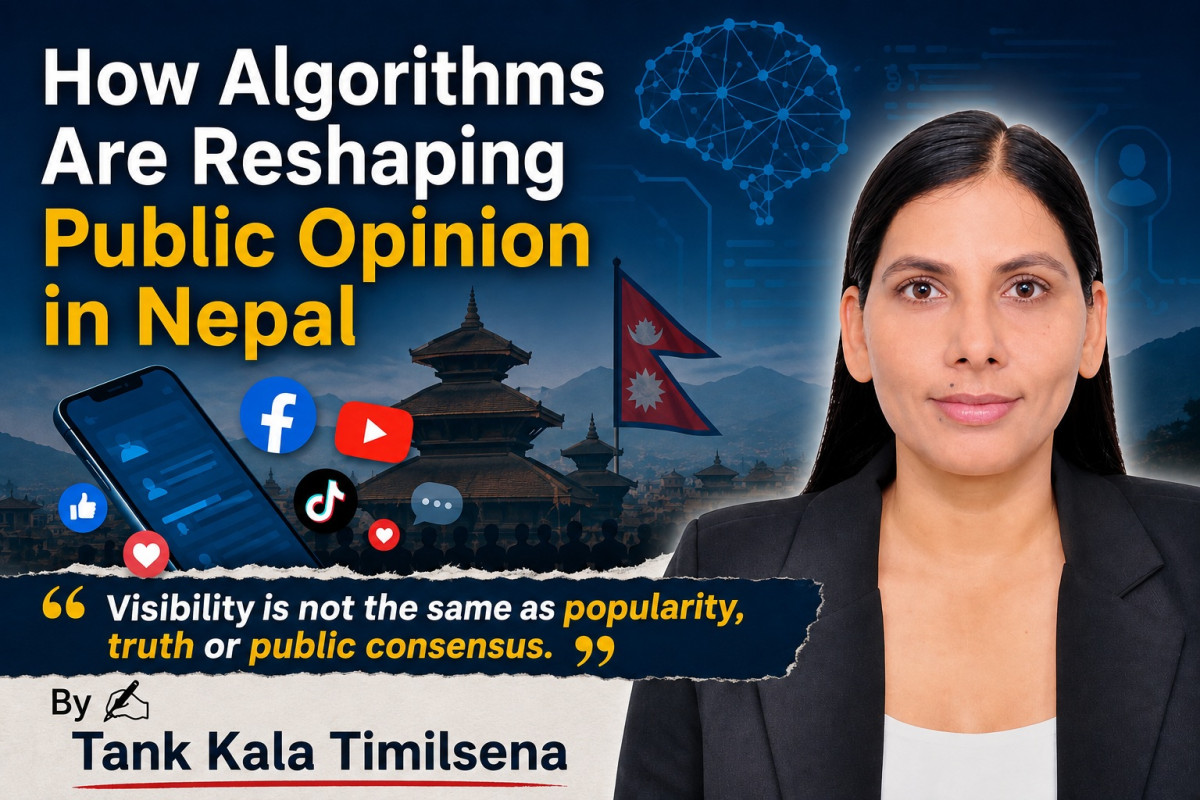
Visibility is not the same as popularity, truth or public consensus. A post can become highly visible because many people interact with it, because it matches a user’s previous interests, because it generates strong emotions or because it is recommended by a platform. High visibility therefore does not automatically prove that the information is accurate. Nor does it prove that most citizens agree with it. A person who repeatedly sees the same political message may think, 'Everyone is saying this.' But that perception may simply reflect the person’s own digital environment.
The misinformation problem
This matter because misinformation can travel quickly through digital networks. Election periods are particularly sensitive. False claims about candidates, political parties, voting procedures and election institutions can influence public perceptions and trust. Recent evidence from Nepal’s March 5, 2026 House of Representatives election illustrates the scale of the challenge.
A Centre for Media Research study reported that 87 percent of identified election misinformation circulated through social-media platforms. The study identified fabricated videos, recycled material presented out of context, manipulated content and AI-generated material among the forms of misinformation circulating during the election period.
The figure, however, needs careful interpretation. It does not mean that algorithms caused 87 percent of the misinformation. It demonstrates the importance of social media as a distribution channel for the misinformation identified during the election period. This distinction matters. Blaming algorithms for everything can be as misleading as ignoring their influence altogether.
The emotional advantage
Another concern is the relationship between attention and engagement. Content that generates anger, fear, surprise or outrage can encourage people to comment, share or watch for longer.
This can create a possible cycle:
Emotional content- Engagement- Greater visibility- Wider exposure- More engagement
Not all emotional content is false. Not all misinformation becomes viral. And different platforms use different recommendation systems. But the structure creates an environment in which attention becomes extremely valuable. This means misinformation should not be understood simply as a problem of false information. It is also a problem of information architecture.
AI is making the problem harder
Artificial intelligence is adding another layer to the challenge. Producing convincing fake photographs, videos, voices and political messages is becoming easier and cheaper. For journalists and fact-checkers, the question is therefore changing. It is no longer enough to ask: 'Is this claim true?' Increasingly, they must also ask: 'Is this media authentic?'
Nepal’s digital environment makes this challenge even more complicated because online communication takes place in Nepali, English, Romanized Nepali, mixed Nepali-English and other languages. Technology developed mainly for English-language content may not always understand Nepali political language, satire, cultural references or local context. Building stronger Nepali-language tools for fact-checking, misinformation detection and synthetic-media identification should therefore become an important national priority.
Algorithms do not decide everything: There is also a danger in discussing algorithms as if they are all-powerful. They are not. People do not form political opinions only because of Facebook, YouTube or TikTok. Family, community, education, personal experience, traditional media, political identity, economic conditions, social networks and trust in institutions all matter. Algorithms are only one part of a much larger information ecosystem. The more accurate argument is therefore not that algorithms control public opinion. It is that algorithms increasingly influence the information environment within which public opinion is formed. That distinction is crucial.
Nepal needs a smarter response:
The answer is not simply to block platforms, nor is it to allow platforms to operate without meaningful responsibility. Nepal needs a more balanced approach. First, social-media platforms should provide greater transparency about how recommendation and ranking systems work. Second, independent fact-checking organizations need stronger technical, financial and multilingual capacity. Third, media and information literacy should become a much stronger part of education and public awareness. Citizens should learn not only how to identify false information, but also how recommendation systems influence what they see. Fourth, Nepal needs stronger mechanisms for protecting election-related information. The Election Commission, media organizations, fact-checkers, technology companies and civil society should be able to respond quickly when false election information begins spreading. Fifth, Nepal should invest in Nepali-language technology capable of detecting misinformation, manipulated media and AI-generated content.
But there is another principle that must not be forgotten. Fighting misinformation must not become an excuse for unnecessary censorship. A political opinion is not automatically misinformation. Criticism of the government is not misinformation. Satire is not misinformation. Investigative journalism is not misinformation. A democratic society must protect legitimate disagreement while addressing demonstrably false and harmful information.
The real question
Nepal is moving into an era in which information is increasingly mediated by algorithms. This transformation offers enormous opportunities. It can make information more accessible, connect citizens with institutions and give ordinary people a stronger voice. But it can also fragment the public sphere. Two citizens can live in the same country, witness the same event and yet receive radically different digital versions of reality. That is why the most important question is no longer simply: Who creates information? It is increasingly: Who determines what information becomes visible, repeatedly encountered and socially influential? The answer is not only journalists, politicians or technology companies. It is the interaction between platforms, algorithms, users, institutions and society. For Nepal, understanding that interaction is becoming essential-not only to fight misinformation, but also to protect informed citizenship and democratic public debate.